Core Curriculum
| 2023-05 | Download |
| 2026-09 | Download |
Accelerated Christian Education’s programme is individualised and non-graded. It is designed to allow students to work at their own level of achievement, which may vary from subject to subject.
The core curriculum is an individualised, Biblically-based, character-building curriculum package. It is this curriculum that the reading programmes (‘Preschool with Ace and Christi’, and ‘ABCs with Ace and Christi’) prepare students to enter. It is integrated with these “early years” programs to provide a quick start for beginning students. However, it will do much more than that. Accelerated Christian Education’s curriculum enables students to progress through high school, successfully preparing them for further and higher education and performance in the world of work.
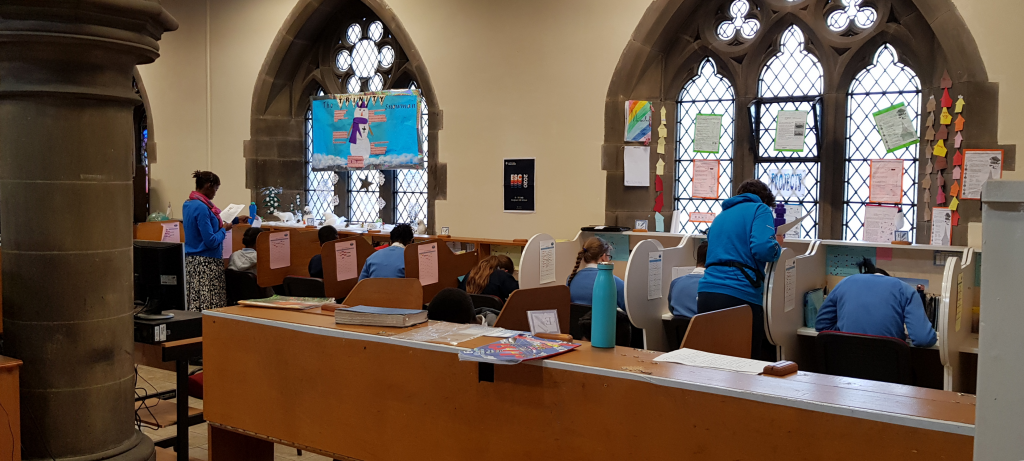
The term “core” is used to distinguish the foundational courses from the enhancement courses in Accelerated Christian Education’s expanded curriculum. The core curriculum provides students with academics, skill building, reading practice, character and wisdom training, and knowledge of God and His Word.
Core Curriculum Provides Students’ Basic Educational Needs
The core curriculum includes the six basic academic disciplines that provide students’ essential educational needs: Maths, English, Literature and Creative Writing, Social Studies, Science, and Word Building (spelling and etymology). Each core curriculum subject contains 156 PACEs beginning with preschool and ending with Level 12. Exceptions are Maths (which contains 144 PACEs), Word Building (which concludes with Level 9), and Literature and Creative Writing (which begins with Level 2 and will conclude with Level 9.)
Each curriculum course consists of 12 PACEs per level. Normally students complete 55-66 PACEs each in one academic year; however, this varies according to the students’ abilities. They maintain academic balance in their subjects, aiming to complete the same number of PACEs in each subject. If they have any gaps in their learning on entrance, they complete gap PACEs, meaning that the students have confidence in their knowledge, building on strong foundations. Students who are more skilled may progress at a faster rate or may accelerate in the areas of their academic strengths. Slower students are encouraged to do their best, but are able to work on their levels of proficiency and proceed as they are capable. Note: The core curriculum is enhanced with DVDs, videos, and computer software.
Typical students work daily on one PACE at a time in each of the six subjects. The PACEs may be on varying levels, according to the students’ achievement in each subject and according to their academic prescriptions based on their diagnostic test results.
The educational concept of A.C.E. was built on five basic laws of learning:
- Students must be at subject levels where they can perform.
- Students must set reasonable goals.
- Students must be controlled and motivated.
- Learning must be measurable.
- Learning must be rewarded.
The 6 Core Subjects
From four-function maths to algebra and differential calculus, the student learns how to approach mathematical problems in a well-grounded, step-by-step manner. Students are encouraged to recognise God as the creator of order and absolutes.
Proper use of English as a language is not innate in an individual, but a skill to be developed. The curriculum does this through its balanced scope and sequence, which includes extensive repetition of the eight parts of speech as well as step-by-step training in research and essay writing.
A.C.E. takes the students’ natural curiosity about their physical environment and helps them build a solid foundation based on Biblical principles. It is non-evolutionary in approach and content. Experiments are performed, and laboratory sessions are featured on DVDs.
Word Building increases the students’ vocabulary and reinforces their confidence and capability in spelling. Basic spelling rules are introduced and illustrated, while the study of the meanings of suffixes, prefixes, and root words allows students to build new words and expand their vocabulary.
Younger students are encouraged to enjoy reading and are led through the foundational concepts of creative writing. Through study guides, older students sample the classics and modern literature, along with poetry from various periods.

Social Studies looks at world history and cultures from the perspective of God as the creator and controller of the universe. The PACEs develop deductive reasoning and include a variety of activities, with examples of individuals who have practised the precepts of God through the ages.